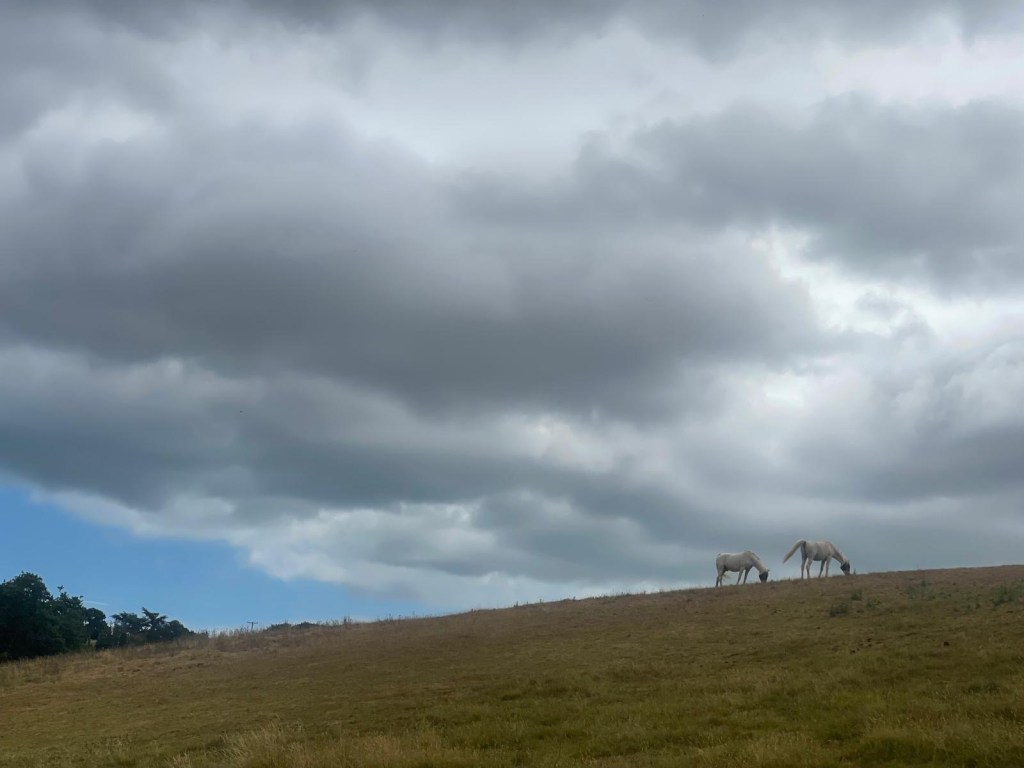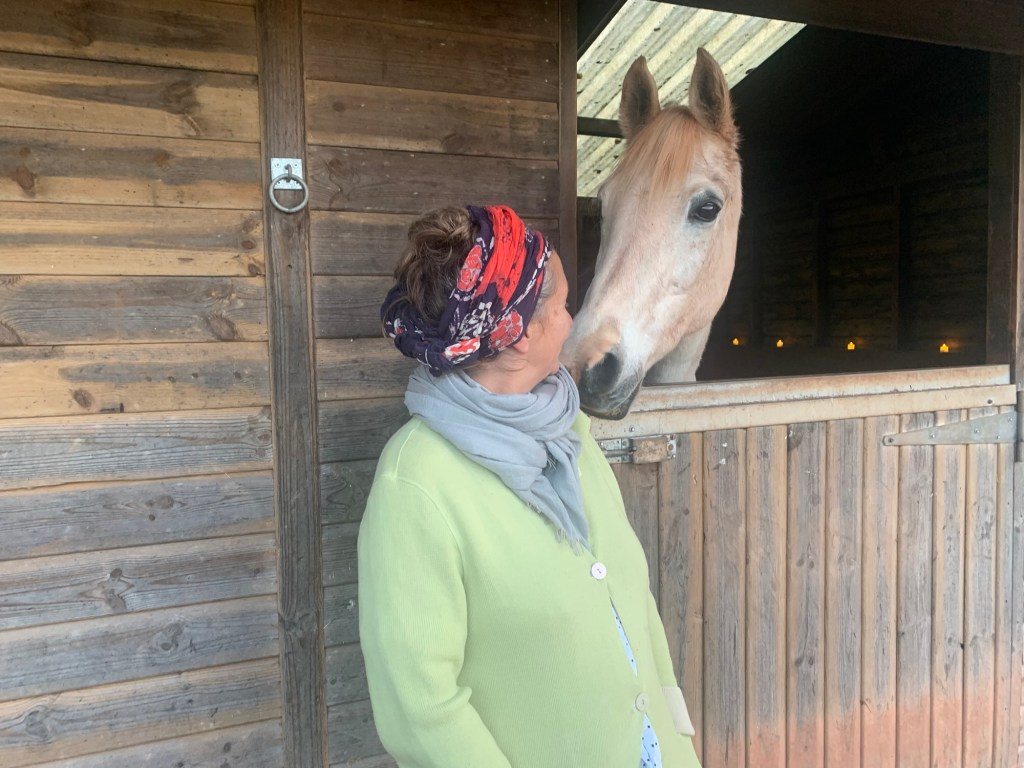
This summer has been marvellous. Days spending time in the sun with the horses, colours of gold and intense aqua blue. A bell tent for shade and storing all the things we need for our retreats. I complete this series of retreats with feelings of appreciation for all the hard work put in by the volunteer team to make them happen. Their efforts, made with generosity, creative thinking and wicked humour have been part of the magic recipe.
Each retreat is something like a theatre production. We pull out of the store, folding chairs, umbrellas, pop-up compost loos, catering tables, water containers, fire buckets, mats for the dogs. The team know where everything is and often they set up within minutes. It’s beautiful to witness.
The main performers stand by and watch. Their main interest is in making sure they are fed before they start work. With the current shortage of grass, two breakfast meals are in order. Besides their stillness, our human activity seems frantic and energy draining. Horses are masters at conserving energy and when we are relaxing and chatting in our chairs, they make their move. Firstly, they check in with everyone present, scanning to see whether someone in the group might need them to be present. A brief touch of the shoulder, a nose dipped to the crown of the head, like a blessing, a benediction, a prayer may come forth, or may not. Horses make decisions based on internal criteria we cannot fathom.
And therein lies the magic, the offering of a process that is as mysterious as it is healing. Magic is when the unexpected happens, when something out of the ordinary occurs, when we feel something whisper at the edges of what we know.
We contemporary humans are uncomfortable around magic. We want to measure experience, collect data, compare one experience with another, run different tests, eliminate confounding variables as much as possible. Our research methods are robust and reliable. Mostly.
Magic makes its way regardless. Maverick by nature, it breaks all the rules because it operates under and over and above everything we can measure. It appears precisely to confound and confront. To amaze, expand and educate. When magic is in the air, everything sparkles and shimmers. Magic materialises when we drop our scepticism, our cynicism, and our over thinking. Magic is something we cannot see when our vision is obscured by mundane mentality. It shifts our perspective.
It’s hard to wrap words around magic. Slippery by nature, it eludes our rational grasp. It refuses to be caught. Mystery is the ocean in which it swims. All summer it has been present, in our responses to the horses, to the land and to each other.
To be married to amazement is something poet Mary Oliver explored in her work, and it was her intention as much as it was her creative quest. To be amazed, we must be ready to receive marvels, whole golden sun-soaked weeks of wisdom, wonder and well-being. In other words, pure magic.
For a long time, I have battled storms that blew up when I was least expecting them, although looking back the first tremors were always there, just under the surface as warnings of trouble brewing ahead.
I want to live in a neighbourhood where people behave fairly, consistently and kindly, and where my needs for peace are understood and met. I want consideration and an end to hostility and aggression. What I most want is accountability. For people to own their mistakes and see their antisocial or aggressive behaviour for what it is – a way of avoiding the truth.
People behave in self-interested ways when they forget they are interconnected with everyone else. A neighbourhood is a community in microcosm. Living in close proximity to others as many of us do means we cannot behave as if we live on an island of one. Except some people do. It always dismays me when I encounter self-interest in the extreme. How to encourage co-operation and collaboration when people see no personal benefit to themselves is, I believe, the question for our current times.
Why should I give up what I want to do for the sake of others? Most of us will confront this question at some point in our lives. Many will use personal gain as a gauge of whether they have won or lost. I got the better of her, therefore I win, is a familiar thought pattern. The I win, you lose mentality is everywhere you choose to look, in all our systems and the effect is to make those who do not operate under this principle feel gaslighted by simply attempting to stand their ground and advance a different way of being.
In the horse kingdom, the bullies and the antisocial herd members are often exiled. Horses understand cooperative living in a nuanced way. They know that if one horse insists on having his own way the whole time, the rest of the herd will suffer. Horses do not tiptoe around issues of an inability to live in harmony. They know what is required for order and they will act to enforce harmony if it is required.
Dogs will do the same. Large roaming groups of dogs live off rubbish dumps in many parts of the world and the dogs are often in competition for the best scraps of food. Squabbles might arise over a bone, which might sound fierce, but is usually over in seconds. Consider how often we engage in petty parking disputes or how long we will keep conflicts going over resources, or how we might withhold food as a weapon of war.
Dogs, horses and other social mammals are self organising in ways that put the whole group interest before the individual rights of one especially powerful or manipulative being. The whole matters more than individual survival. The whole promotes the individual to flourish.
In organising their societies so that everyone may flourish, the animals are putting into action, principles for harmony promoted by the Ancient Greek philosophers such as Socrates, Plato and Aristotle. They advocated friendliness as the makings of a good life.
Neighbourhoods can be wonderful places of mutual support and goodnatured cheer. They can also become sectarian war zones, divided by walls and barbed wire. Children growing up in such places learn to hate and to fear. Friendliness is valued less than the ability to judge and take sides.
Perhaps it is because friendliness comes so naturally to us that we don’t value it as much as we could. Indeed, we often pay any attention to it only when it has gone.
To return to friendliness as our starting point for all our social interactions, would literally change the word. If we adopted the open-hearted way of dogs who are well socialised or horses who live with other animals they trust, every encounter we make could be beautiful and could advance society faster than technology.
Watching The Shark Whisperer last night made me wonder about human aggression and fear. More than 100 million sharks a year are slaughtered because they are not considered valuable enough to live in the oceans they have inhabited for periods of time long before we humans even existed. The world is out of balance and we have made it so. In trying to tip the balance in our favour, we have distorted all that is natural, beautiful and wise. Many of us are brokenhearted at what we have done.
It is not too late to make amends. Conflict , suffering and destruction can be healed. For every hurt we inflict, there is a way to honour instead, to create, build bridges and show love and respect. To begin we can look to the animals who do much of their living in the realm of silent consciousness, the place of connection beyond words.
We know that place, too. It is the shelter from the storm, the refuge and place of safety we call home. The place where we all land together.
Horses first welcomed me into their world a long time ago. I was a dreamy child of ten in need of true connection and I found horses, or maybe they found me?
I have cared for my own horses now for more than two decades, an astonishing span of time. One of our younger volunteers who has known and loved our horses for a couple of years remarked this week. ‘I find it hard to get my head around the fact these horses are older than me.’
More than twenty years ago I had an ache to connect with horses again. I didn’t know why. I just needed to be with them. Maybe some part of me knew I would need them to save my life. As I shared in a TEDx talk, educating my horses gave me a way through the pain of losing my closest friend to suicide. They showed me that it was possible to find joy in the midst of heartbreak. They showed me how to live well and taught me startling lessons of recovery, resilience and now relinquishment.
Since we incorporated Horsemanship for Health as a Community Interest Company more than nine years ago, we have worked with a range of people from young people who struggled to attend school, to women experiencing severe trauma after domestic violence to Royal Marines and senior Navy personnel who experienced catastrophic breakdown after tours of duty in Afghanistan and Iraq. From long-term psychiatric patients sectioned under the mental health act to children who needed loving parenting – often seeing both disparate groups on the same day another volunteer wryly reminded me this week – the horses have met every person with compassion, courage and curiosity.
In the early days of building our enterprise, I worried that there would come a point when the horses would say ‘enough’ and would refuse to engage or make it clear they needed time off from spending time with traumatised people. Instead, something more remarkable has happened. Every single one of our team of nine people has experienced trauma and intense pain. Every one of us has undergone terrific life challenge and every single one of us knows the agony of not wanting to live. The horses have accepted every single one of without judgement. Far from saying enough is enough, as our team has grown and is still growing, the horses have embraced us all as if we are life-long friends.
Witnessing Sheranni lift his head from the grass and stride over to the gate to wicker a greeting to our youngest volunteer who he had not seen in weeks melted our hearts this week. Horses don’t forget true connection. They value it. They understand it. They live it.
And their value system of unconditional acceptance combined with a way of life that gives them the freedom to make choices, is why they remain open to whoever steps through the gate. Nearly ten years in, I am reminded by my master teachers to keep looking with fresh eyes.
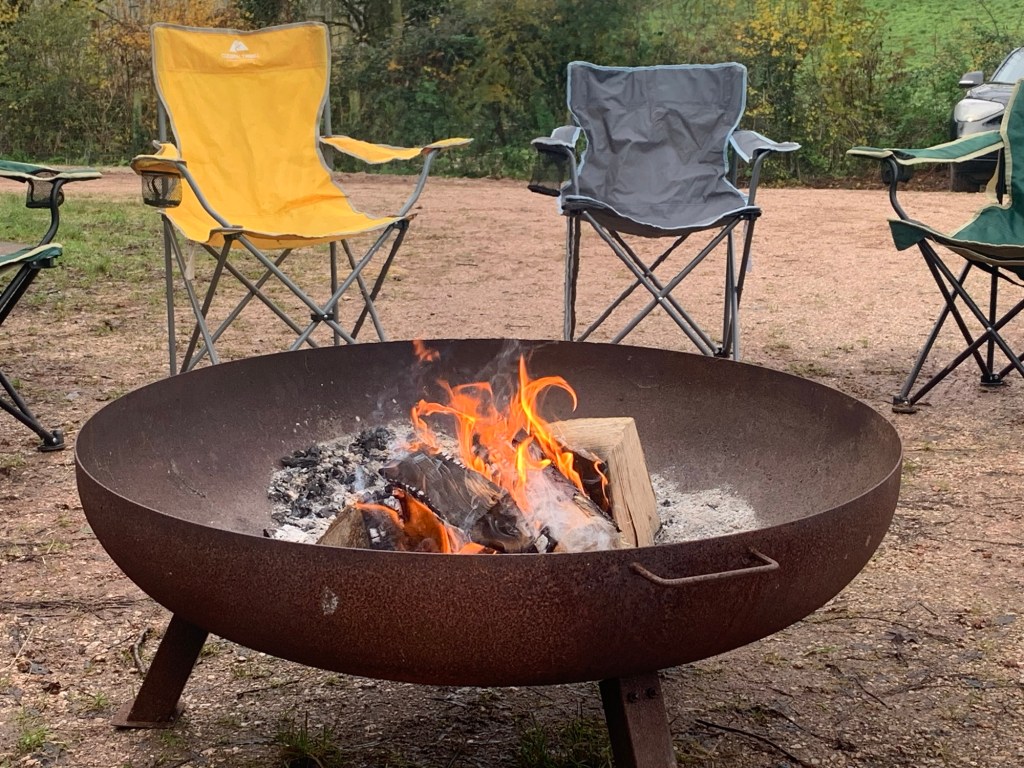
The wind-driven rain pours down the hill this morning like wreaths of misty smoke, reminding me of recent more settled days when we gathered in circle around our fire pit.
The smoke swirled then, at once concealing and revealing the hurts and the heartbreaking circumstances that led us to meet. We all carry wounds and we all try to hide these wounds from each other so as not to expose them further. At times there is so much raw pain in our circles; there is laughter, truth, tears and shared stories, too. The stories belong to those who carry them and they are secrets waiting for an invitation to become part of lived experience. The unburdening of pain and secrets releases us to become more open, and vulnerable than we dare to in ordinary life.
It has been a privilege to host our latest series of circles. Each time we gather in this way, I learn something new about love and loss. This time I saw how pain freed from its chrysalis can transmute into creativity. Poems, drawings, inspired ideas and radiant connectivity all emerged in our last round. How can it be, I wonder that such a simple container as a human and animal circle can hold so much that is healing and wholesome? So much that unites us? In a world increasingly torn apart by dichotomies, schisms and polarities, to join together in this way feels radical. It feels like hope, a tiny flicker of light in the darkness. We all trust the circle is strong enough to hold us as we open our hearts and find the courage to let ourselves be seen.
There is a wealth of talent in our small team of volunteers, each person genuinely gifted; we are all so diverse and various, indeed we laugh about it…how can such an eclectic bunch of people get along? We have come to see that belonging is not the same as fitting in. Belonging allows us to remain as we truly are, and because we are free to be who we are meant to be without role playing or masking, we can honestly connect with each other. And these are the most fertile of conditions for creativity to flourish.
We were all touched by the poem written by one of our volunteers and she has given me permission to share it here. Written from the heart, it speaks to us all.
Wespeak into the smoke. It curls around us, landing soft snowy embers on shivering shoulders, dotting black jackets. At first, I feel relieved to hide behind it. It feels safer, to speak to the grey, not seeing the eyes or listening faces. But as the smoke weaves its gentle arms around the circle, it starts to pull us in closer. Are the tears mine, or do they belong to the ash? I lean forward onto my knees, and my eyes sting, but I can feel the warmth, the embrace of smoke, and both are telling me it’s okay. You’re safe here – you belong here. You do not have to hide behind me.
We’ve abandoned our chairs. Restless movements to fight away the chill, blowing misty plumes into the air. The smoke has settled. It’s snoozing over hot coals, and it draws sleepy breaths in and out. We watch it, stood closer now. Reach out hands stained lilac and pink by the cold, offer them to be held by the fire’s warmth. I’m not hiding any more. Our circle drifts and breaks, separates and comes together again, but no matter where we are, how far we fall away into the cold…the amber glow of flames draws us back, and they whisper tell us your stories. Share with me your joy, and your sorrow. I will hold both.
I’m not speaking into the smoke any more. I’m speaking to faces, listening faces, and they laugh, and speak back, and it feels like the fire has taken root in my chest. Or at least, something just as warm.
Starting a new year can be hard when you have been unwell for a long time. We know mental health recovery follows no calendar and new beginnings can feel daunting. We may be facing more chilly and stormy weather ahead, but the warmth will return, and so we move forward, one small step at a time.
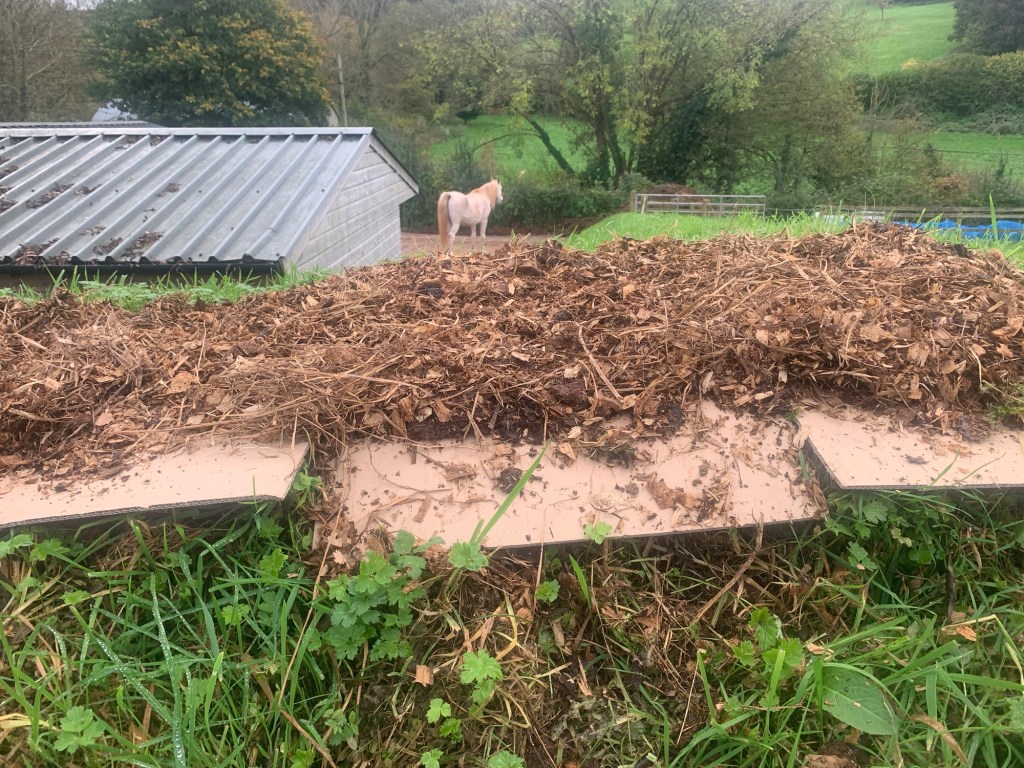
A few weeks ago I pushed a few barrow loads of compost onto a bank lined with cardboard to make a horse herb garden. I mixed the herb seeds with horticultural silver sand and let them do their thing. In the past few days the seeds have sprouted into green shoots. I am checking these every other day now to see how they might grow into proper plants we can either let the horses eat from the bank as a natural pharmacy or harvest to dry and add to their feed.
There is a childlike joy in creating something so simple and nourishing. Looking at the sprouts on the bank reminds me of my first attempts to grow mustard and cress in a saucer on pink blotting paper. The delight of new life is a reminder that joy can come to visit in simple form.
For a long time, I felt uncomfortable about introducing the theme of joy into our sessions. I knew that many, if not all, our visitors, had experienced lives of despair. To speak of joy in the midst of such suffering and pain felt provocative. I was told by one gentleman that he had never experienced a day of happiness in his life. How could I speak of joy to him? He had nothing to share of the light only darkness. I remember how sad I felt for him hearing this. I could not imagine living without joy and I felt privileged to count it among my life experiences.
Listening to writer, teacher and community gardener Ross Gay this week has helped me to view joy differently. It is not a luxury to be delighted, he says. Joy is not just sugar coating. It is more radical than we think it can be. Joy is a form of protest, a way of looking at the world and seeing beyond our suspicion, cynicism and hostility. It is easy for us to keep fighting, Gay says. Much harder to open up to delight. As way of testing his idea he gave himself a year of recording every day delights. And his funny stories of ordinary scenes in cafes are moving and beautiful and inspire me to take notice of the small eruptions of delight in my own life.
It was not exactly a joyous week. A few nights ago tired and achey with flu symptoms, I took a shortcut home up some steep steps in the dark and fell and lacerated my hand. The cuts were deep and jagged. At the hospital, plastic surgery referral was mentioned. A student medic was brought in to have a look at the mangled mess of three fingers on my right hand. I whimpered with the pain. Even so some part of me remembered that only a few days ago I was speaking about how joy and pain could co-exist. Was I being tested now?
With my fingers cleaned and wrapped in a white dressing, I waited for an x-Ray. On the seats in front of me were two elderly Polish women. Most of us waiting for imaging were stricken, stiff with anticipation. Not these women. They were softly animated, chattering away, smiling with light touches to the arm and a graceful way of listening and responding that spread across the waiting room like balm. Here is my delight, I thought. Here is something else other than my rigid focus on knowing whether my fingers are broken.
They weren’t. And so the second delight. A clinician who bandaged each finger with such dexterity and care, I forgot the pain and became fascinated with the procedure. She used a surgical steel nozzle, like a piping tool for a large wedding cake, to twizzle the bandage in place. Told me to come back to get it checked and snapped off her surgical gloves ready for the next patient.
A hospital injury ward was the last place I would have expected to find joy but it was undeniable- I just had to unstick my mind to meet it. And mark it. I’m noticing more delights each day. The Robin who sits in the pink plastic party plate and eats the wild bird seed I put in there every morning. He flies before me and shows me his secret hiding places. Today I heard that the Robin population in England is up by forty percent and I cheered out loud. Hooray for small victories.
The pain is still there. I can’t type properly and putting on a coat is laborious and frustrating. I am appreciative of my fingers which still work- what a marvel is the intricate human hand. Not being referred to a plastic surgeon means my tendons have not ruptured and each time I have the bandages taken off I see signs of healing and repair.
I am joyful and I am sad. The last time I visited the hospital I took in my friend. We relied on each other to do the driving when one of us was injured. Our drives to the hospital were always joyful even when we were in agony. There was one particular year when we both had a run of dog related injuries, and usually the dogs came with us in the car. Our friendship had a festive feel. I passed the coffee wagon where I stopped the day I took her in. I bought coffee and sticky polenta cake that day. I knew I would need something to keep me going.
My friend was admitted to another hospital for ten days where they ran tests and she discovered she had incurable cancer. Typically she asked her oncologist to give it to her straight. How long have I got? The oncologist said between three months to a year. My friend said to me: I’ll take six months.
She lived for just six weeks of her six months. In those weeks I saw her every day. I took something delightful each day. Sweet peas from the community garden, small bright courgettes and rainbow chard, freshly pressed organic apple juice, roast chicken dinners, fish with coconut rice, roasted vegetables, soups made from proper stock, including one made with pressed tomatoes. I took my time. I wanted everything to be lovely. We laughed a lot in her front room where she sat in her winged armchair which held her diminishing tiny frame. On her last day I took a bunch of vivid crimson, flame and aubergine coloured dahlias from an honesty stall and put it on the kitchen table where she could see it. After she died, the hospice nurse took the crimson and flame coloured blooms from the jar and placed them on my friend’s chest close to her heart.
My friend and I laughed every single time we met and the joy of our connection remains. I am less coy about introducing more joy into my work because I have witnessed the strength and healing power of looking through pain to the edges where the light streams through like a crack in an old wooden door.
Joy is my light teacher. I have much to learn from her.
Spiritual teacher Kabir Helminski was given the task of grooming a horse one day at what he called ‘spiritual school.’ His teacher instructed him to groom the horse from head to tail. Kabir worked hard. He spent hours with the horse, absorbed in his lesson. When the teacher came over he was unimpressed and told Kabir his work was sloppy. Understandably the student’s heart sank. You might think the lesson was: try harder, next time, pay more attention, don’t cut corners on the difficult parts, those feathers on the fetlocks need more brushing.
The teacher was joking, playing a game with Kabir to see whether he truly was paying attention to what mattered. Kabir understood he had not spent hours polishing the horse to a shine to get a reward from the teacher. He had groomed the horse by paying attention to the task, brush stroke by brush stroke. The reward of a well-groomed horse was not the point. The success or failure of his lesson was not going to be determined by outside validation. If Kabir had done his best, that was all.
We are so conditioned to reward, to the polarities of success and failure – our entire education system is built on these twin shaky poles – that paying attention in and of itself seems to be worthless.
Addressed properly, with respect for what we know to be true, attention can glisten like fine silken spiders’ webs in autumn sun. Attention can lead us toward the delightful state of not needing approval.
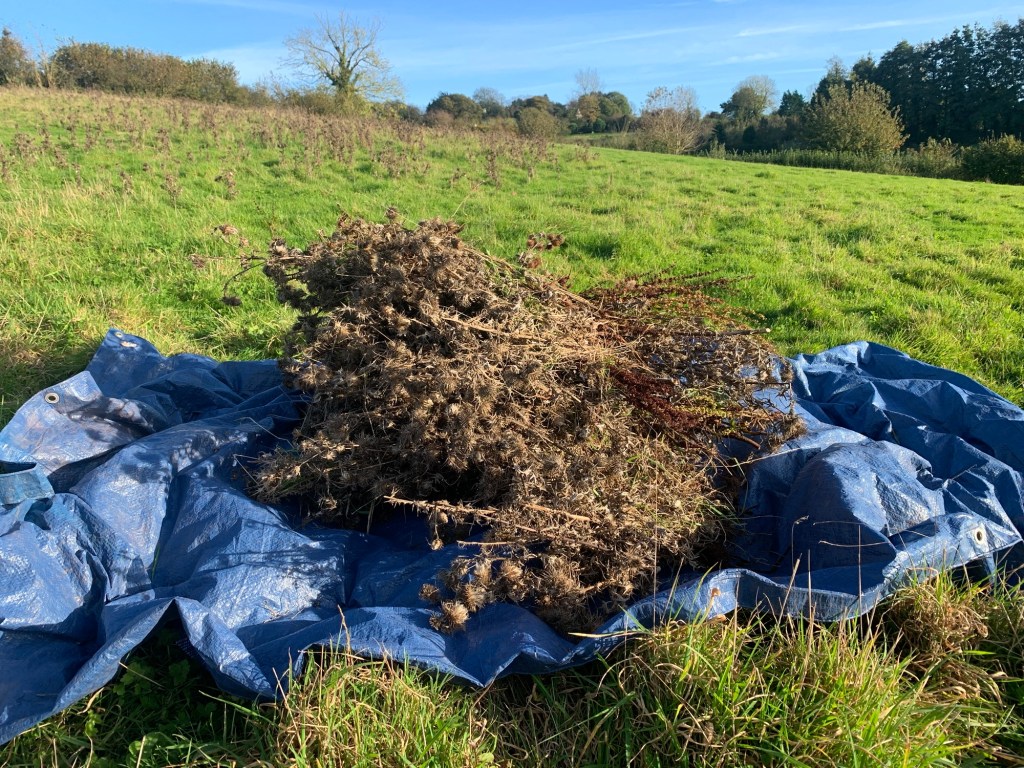
I recognised my own conditioning in anticipating reward as I pulled up thistles in the horses’ new pasture. It was at first absorbing work and I set small goals of areas to clear, finding my motivation rising as I neared the end of one section and got ready for the next. My mind made a little game of the activity. I will do this patch and then have tea or play with the dogs or read or send messages. This approach to work is ingrained and possibly has something to do with years of working in schools when work time is sliced into thin sections – in my case, currently, an eight period day.
Breaking large and difficult tasks into manageable chunks is sensible and practical. I am not going to write a whole book in one go. I will write a sentence and then another and each day I will have a few more sentences which will eventually become chapters.
I approached clearing the field like writing a book. I would say I have a first draft now. I know what I am doing and I have a system. Alongside my efficiency, I have given room to thornier questions such as – do these thistles want to be pulled?
They come out of the ground so easily, I have read this as a yes. And thistles have many, many seeds and of course they will be back. Next year. I will be pulling them out of the ground for a long time. And if each thistle were a thought, that would mean I would be endlessly engaging with barbs and spikes and splinters, which sums up any stream of consciousness. The prickles of the mind snag my attention moment by moment. The work of presence, as Kabir teaches it, is to recognise when we are hooked and to gently detach ourselves from distraction.
The average attention span of an adult is 8.25 seconds. Children and young people do so much better – they sit down and write stories, complete geography projects, build castles, compose music. Last night, a 14-year-old pianist named Pacey Shephard stunned a church audience with the brilliance of his playing. From his own haunting composition Rumours of War to a virtuoso arrangement of the theme from Star Wars he was so absorbed in the piano, it was as if we were not there. To our rapturous applause, Pacey took no bow. He had already redeemed his reward. It was no reward. He played with every part of his being. You could feel it.
Total attention is not possible all of the time. Kabir is not suggesting we try to aim for an impossible focused ideal of uninterrupted awareness. He knows having studied with many master teachers, how difficult it is to pay attention even for a short time. Struggling and failing will not teach us how to do something better whether that is grooming a horse, painting a shed or pulling a thistle.
It is only through being aware of what we are doing in the moment of doing it that we become free of judgement and commentary. It is hard to give up our stories of virtue and blame. Hard to live in the precise present.
Over a decade ago I started a community philosophy group. A group of people interested in philosophical enquiry met once a week for six or seven years. We talked about happiness, about power and greed, about truth, about kinship, about friendship. We discussed these ideas earnestly as if they were life and death matters. Some of the topics challenged us to overcome assumptions and biases and just plain stubbornness. We all got along. No one stopped speaking to each other. We laughed as much as we argued.
I miss those weekly discussions. I miss the friends I made during those intense evenings. Every now and then, I am tempted to start another community group and then I remember that to truly understand philosophy, you have to put some of its ideas into practice. For philosophy to come alive beyond the seminar room, it has to encounter the sticky terrain of real life.
By chance this week I met a student from those early days and as we caught up on news, he reminded me that a decade had passed since I launched those community classes. He wanted to know what lessons I had learned in a decade – what wisdom could I offer from this stretch of time?
I fumbled as tried to wrap my mind around ten years. Did anything leap out? Only how incredibly packed those years had been. Only my astonishment at having to confront a span of time and try to condense it into coherent lessons.
Life is teaching us something every moment. To reach back over the decade and try to extrapolate something useful and pithy to share for the benefit of others is beyond my scope. I know only that I learned some lessons that have brought me closer to understanding my role as a teacher of philosophy as a facilitator of wonder and curiosity at the world itself. Not to provide the answers, but to stimulate the questions.
If just one of my philosophy students got to considering life’s huge questions without expecting answers, that would open up the world to them and all who connected with them. That would be a lesson worth learning.
Because my student asked, though, I have given the question some thought. What has been important in my philosophical journey is the shift of emphasis from ‘why’ to ‘how.’ In the early days of learning I wanted to know why we existed at all and why certain situations turned out the way they did – why did some people struggle so much and others seem to glide through life relatively easily? Why are relationships so testing when we need other people so much? Why is the world lurching from crisis to crisis when we are more educated than ever before? Why are we not learning the lessons we need to learn about to living alongside those with whom we disagree?
The question for me now is not why, but how. I know from deep personal experience how easy it is to fall into why questions about the sudden and seemingly cruel nature of loss. At this point in my life, asking how I can live with heartbreak and still find joy is the ultimate question, indeed the only question I wish to explore.
There are many ways to live with how. I will leave you with three questions which may never get asked in a traditional philosophy seminar, and which are most pressing right now:
How do I get up and feel the pulse of life when it is dark?
How do I navigate my way through a day filled with minor irritations without adding my own?
How do I find connection, community and companionship in true heart bonds?
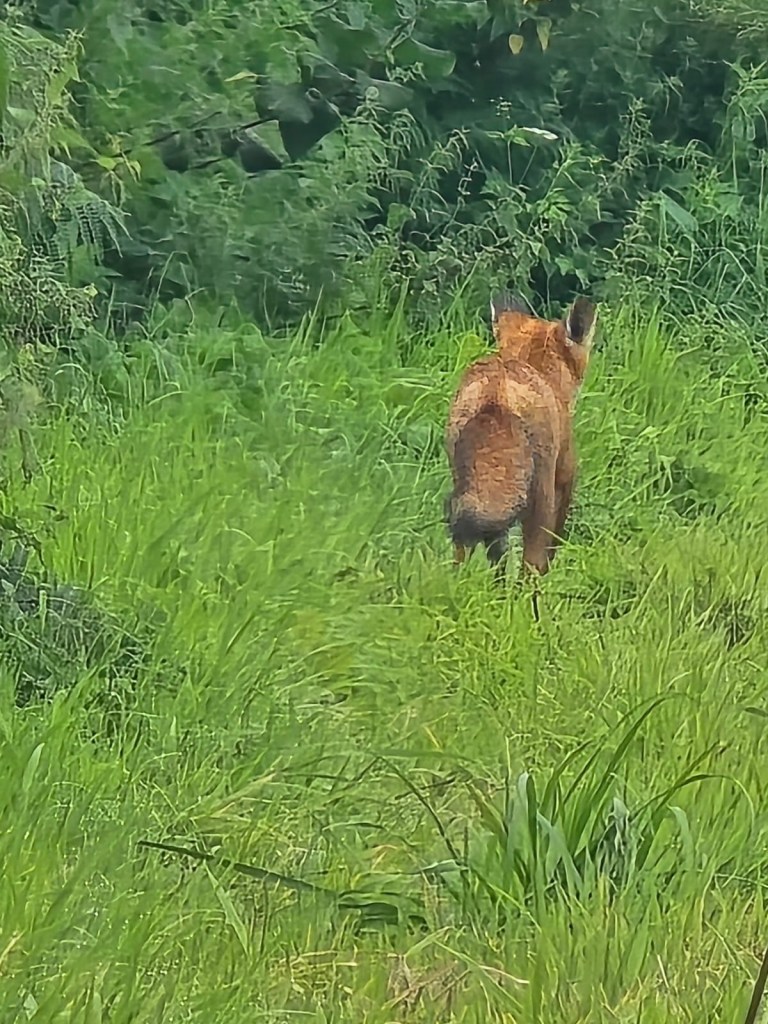
How do I live more attuned to my senses like the fox I saw most evenings as summer sank into autumn?
This past week I have stayed on the North Cornish coast where the Atlantic Ocean carves valleys into mountains of dark grey rock, creating a landscape both shifting and solid.
Time away has pulled me into a different rhythm. Slower (I took my laptop which stayed closed all week) and simpler. Early mornings with only one task to complete – boots on over pyjamas and a walk up the lane with the dogs – feeling the mist, the cool of autumn beginning, scenting, sensing, finding my way through torchlight. I wanted to embed this space in my memory for when life becomes cluttered and full again.
I rarely take time out. Like many social entrepreneurs, my work is my life. In the past eight years, I have been away only a handful of times. It is ironic that I can host retreats, time out for others, and not make room for replenishment myself. This week away has been the easiest of weeks because I have not fretted too much about all that I have left undone. In the days leading up to going away, I made arrangements for horse care- thank you to our wonderful volunteer Emma – and settled a few things that were important. As best I could, I cleared the way for time off.
Each day away became a container I could fill with activity – reading, writing, walking, cooking, cleaning and good conversation. Each day felt precious. My sister and I have been away a few times and each time we find our flow and it is nourishing and freeing and beautiful to spend time together. We both lead crazily full lives and taking a week out feels important and vital.
Writer and aviator Anne Morrow Lindbergh writes about spending a week with her sister in a simple beach shack. In Gift from the Sea, her book of luminous essays, she reflects on time and what makes each day so perfect. As it is with our week, the two women set a pattern of freedom, of not being cramped in space or time or limited in activity. The sisters do not lie on the beach doing nothing – their days have a natural balance of physical, intellectual and social life. The rhythm is easy and unforced.
“Work is not deformed by pressure. Relationship is not strangled by claims…we have moved through our day like dancers, not needing to touch more than lightly because we were instinctively moving to the same rhythm.”
Thrown back into the hurly burly of our lives, it is difficult to detect the underlying pattern, and find our natural rhythm. So many of our systems and organisations work against our nature and we lose our balance. Exhausted and depleted, we take time off to recover only to return again and again to the same old cycles. Sometimes, and this has been true of my life, we cannot take the extended rest that would reset our balance, we have to work with where we are.
Anne Morrow asks questions about the intermittent nature of our being. “How can one learn to live through the ebb-tides of one’s existence? How can one learn to take the trough of the wave?”
Watching the sea withdraw and return brings her to understand that ‘each cycle of the tide is valid, each cycle of the wave is valid, each cycle of a relationship is valid.’
Coming home the undone work sits on my desk, still, and I am not dismayed. I see that it is part of the pattern. Inspired and refreshed, I find I am moving in a new rhythm, carrying with me the image of the Atlantic rolling and falling, wave after wave, splitting and reforming, endlessly moving.
One thing about illness I always forget. It takes us by surprise. I knew I would probably get Covid. I shook the hand of a gentleman I knew was ill – streaming ill – enough for me to think – maybe I shouldn’t have done that? But I did and I have just recovered from three days in bed as the virus took its course.
Before I got ill this time, I spoke of the virus as the great disrupter. Weddings, it was my nephew’s wedding where I met the virus again, funerals, christenings, birthday parties, celebrations, humans are meant to gather, and we resent the intrusion of the unwanted guest. If Covid had not been present at this particular occasion, we would all have been better off. Guests would not have had to wear masks or leave early or continually wash their hands or wonder if next week they might have to rearrange their working days.
Covid is as common now as a cold. It has taken its place in the family of diseases we have to embrace each year. And because it has become so familiar, unremarkable even despite its devastating impact on the world, we have become indifferent. We don’t pay it respect.
I thought I would isolate and wait for the fever to subside. Once I started feeling normal and tested negative, I would return to the world. This is one level of engaging with the virus. The deeper level of engagement has also taken me by surprise.
On day two I was really angry at the virus for creating such havoc in the world, for existing only to create pain and suffering and terrible hardship. I was also irritated that I would have to rearrange my whole week around its needs instead of my own. Horse care – thank you incredible volunteers- garden and project management- again thank you wonderful volunteers. Online Meetings – thank you supportive NHS colleagues. Shopping – I didn’t feel like eating so no problem there, and walking the hound. We managed to get out to do what he needed to do and mostly we rested inside and played with slippers and thinking games when he became bored. I had it covered.
On day three when I felt worse, I started to question my perspective. What if Covid were not here to be dismissed, eradicated, derided as the great inconvenience of our modern times, what if we started to respect it more? Listen to what it had to say because, like any annoying visitor, it has come because it needs a place to stay.
If we unleashed Covid on the world – accidentally or not – there is even more reason to look it in the eyes and ask it – what do you want? This is the thinking game I have been playing with the hound. Tell me what you want? Do you want to go out (eyes brighten, ears waggle, nose twitches – yess!) or do you want more food (eyes soften, ears flatten, nose rests on paws, head tilts towards his feed bowl – yess!). It’s been much harder to read what Covid wants, but I have been asking, impatiently at first, and as the sickness took hold of body and mind, more respectfully.
Respect was not a word I would have considered putting into the same sentence as Covid but after a conversation with my sister who is also ill and off work, I realised that I have been denying the power of illness. I have absorbed the Western medical mindset which allows us the freedom to disrespect anything that gets in our way. We expect good health if we look after our diet and exercise and breathe clean air. When illness comes along to remind us of our frailty, we get outraged.
Covid has given me time to pause and reflect. I’ve read good books, listened to podcasts even diagnosed and repaired my shut down fridge. Mostly, though, I have listened to it. What do you want, I have asked it, time and again?
The answer is sobering. I want you to respect me. To know that I have power. I want you to see me for who I am. And I am beginning to see that shift of perspective around illness – just because I live in a privileged society with all its ability and capacity to respond to disease – does not mean that I am immune. I am smiling because even as I write this, I know that I am not going to stop trying to improve my immunity and have even ordered a book on the subject. Not because I want to get well fast. Not because I want the secret of long life or good health, or any of the promises offered on the covers of such books. I want to explore deeply what it means to live with the constant presence of recurring illness and make room for it in my life. It is here to stay.
Danny is a native pony who reads energy like a zen master. Put yourself in a slightly off position or approach him without making your intentions clear, and he’s immediately suspicious. He needs to feel that you are grounded in the present before he will connect. I have spent a few months getting to know Danny and in that time he’s taught me to become more respectful in my approach. He’s given me lesson after lesson in how often my mind is distracted even when I think I am focusing. If Danny were a Zen monk, and maybe in a former incarnation, he was, he would be beating me with a stick. Stay awake. Stay awake. Stay awake.
It takes impeccable energy to stay awake. Everything calls for your attention. Danny standing under the elder bush in the hottest part of the day. Dragonfly asking for reassuring scratches and contact while he waits for Danny. Sheranni sauntering over to see why I am spending time with Dragonfly. Play barks from the hound when he senses I am absorbed in horse time. The broad beans collapsing under the weight of their own pods. Rabbits nibbling the carrot tops. The flowering, budding, drooping, flourishing cycles in the community garden. The running, resting, ruminating and relishing cycles of being animal. Rain water in the can. The sound of spray whisking over dry earth. Energy in Everything.
Brilliant thinkers and writers among them Lynne McTaggart, Jude Currivan, Thomas Hübl and Jeff Karp are influencing my approach to energy. Instead of thinking of energy as something that might run out, especially if I try to cram too much into an already full day, I am now thinking of energy as a wave that regenerates itself. My shift in thinking is leading to a greater sense of noticing where the energy is and where it is not. Where is it flowing and where is it flat? And this form of attention is proving more energising than my former pattern of moaning about never having enough time. As if there were some ideal plateau of spaciousness I might one day reach if I put in enough effort.
Our well-being enquiry this week focused on energy and I realised that many of us have been conditioned to doubt the power of our own energy. Tone it down. Be realistic. Live within limits. Don’t get carried away. Stick with what you know. We are given advice to stay small. To temper, dampen and dull. Energy requires us to live on a higher frequency and we are just not prepared for this form of vibrancy. We are told all our lives to conserve energy, to be in control, to play it safe. We are warned off living with our full colour spectrum on display.
The sea is not told to stop flowing in waves. Birds are not scolded for singing so loudly they intrude on our session. The wild poppy who appeared overnight and amazed us all is not shamed for being so brazenly beautiful. The pony who chooses to leave when he feels uncomfortable and return to a cool space where he can rest is not judged for being fickle.
Natural rhythms are energy and we are part of this wave. Everything we do sends energy. Everything we say. Every intention. Every thought. Every glance. Every footstep. Every touch. Stay awake. Stay awake. Stay awake.