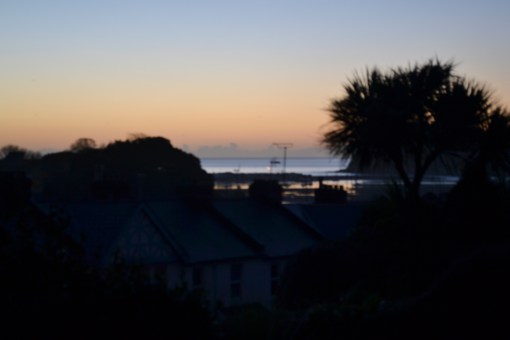
The world didn’t end, the sun rose over a silver-grey sea and the seagulls shouted their heads off as usual. Inches of light to come now.
The world didn’t end, the sun rose over a silver-grey sea and the seagulls shouted their heads off as usual. Inches of light to come now.
In sport, more play time is given at the end of some games to compensate for time lost to injury. In life, there is no such luxury. Injury time is part of the ordinary run of time, and there are no bonus hours of living to make up for time lost in the playing. Injury time is headless of plans and projects and must be accommodated on its own terms.
Being injured is something I’ve forgotten. It is nearly eight years since my knee injury and I thought I had cured it with regular walking and exercise. After a couple of minor falls on slippery mud and on ice, my knee has given way again, and this time I know that it is more serious than the first time. This time I know that it will be months before I can return to the level of activity I was taking for granted less than a week ago.
In less than a week my world has both shrunk and grotesquely enlarged. When I look at ordinary spaces transformed into parkland for giants, I feel like Alice in Wonderland. On the first day, I couldn’t cross the kitchen. Today at the hospital, a car park stretched like an expanse of grey English Chanel. My car, on the other hand, feels like an old wellington boot: a perfect fit.
Like many people who use their minds for a living, I reside mostly in a non-physical space and regard my body as the other part of me, the bit that accompanies my head. I keep fit, eat my greens and generally look after my body, but my sense of ‘me’ is not my hands, chest, shoulders, hips, thighs, knees or feet. I am not my flesh and blood. If I were a horse, I would be located in my loins, or my heart, or my powerful lungs. If I were a dog, I would be my sense of smell or my hearing. If I were a cat, I would be my balance and my timing. If I were a mouse, I would be my nerve endings. A falcon? I would be my eyes.
Because I am human, I am my thoughts. There seems no escaping from this and it is why people wish to be birds and why a friend once said that that the reason we admire and love animals so much is because we envy them.
Being injured returns us to the body. I have become disproportionately right-kneed. I wake thinking about my knee and spend all day making adjustments for it so that the rest of me can come through. I feel subdued, muffled by my lack of vivacity and also bemused because I now have a stick, a particularly fetching aluminium standard NHS issue elbow crutch. It is useful. It is my rudder. Because straightforward walking is not easy, I’ve been dreaming of movement in other dimensions. I want to recapture fluidity. I want to dance, to run, to climb, to leap, to move unequivocally.
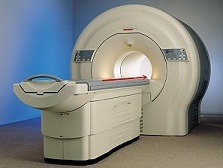
But in order to do so again I have to give injury time its proper due. So far, this has meant reading and eating a lot of chocolate. It has also meant this morning a visit to the mother of all magnets, the giant doughnut of the magnetic resonance imaging (MRI) scan. I was given yellow foam earplugs, but these still did not dampen the soundtrack that opened with clanging church bells and ran through a range of other frequencies including power drills, garage music, metal grinders and ships’ anchors being slowly winched ashore, and all of this was just action on my water molecules.
MRI scans work by rearranging the protons at the centre of each hydrogen atom, making them stand to attention all in one direction, like a magnetized cadet force. Protons pulled out of normal position emit radio signals and these can be mapped to create an image of the body. After the scan – it takes a surprisingly long 40 minutes – I asked the radiologist if I could see the pictures. He showed me one of the anterior ligaments still clinging to the bone and a blurred section inside the knee. ‘That all looks pretty mushy.’
Pretty mushy is accurate. My knee has the consistency of pond sludge. There is not much I can do to get things flowing again. Injury time will not be coerced; it will not be hurried. I must concede to it.
But still I can’t help wondering what I would do with the time if I were given say a fortnight at the end of my life to play out for free. Where would I go? What would I see? What would I stop doing immediately?
I’m going to have a think about this and report back next time

When I first set out to write, I had no map. I put my mind into gear and lurched down the road, wobbling all over the place like the learner driver I was. Over months of practice I learned how to steer without mounting the kerb and stop at junctions and reverse round corners. Sometimes when approaching roundabouts I even remembered to give way to the right. When I felt pleased with my progress, I wound down the window and had a cigarette, usually while driving home down the dual-carriageway.
It took me four times to pass my test, though. Four novels: three published, one still in waiting for the right publisher and the right moment. Each one taught me something essential about going the distance.
Four novels equates to nearly half a million words. If as a teenager I had been told that I would spend most of my adult life sitting at a typewriter or in front of a screen searching for the right words, sometimes spending ten minutes or more on a single sentence, I would have taken a long walk, and not stopped until I had outpaced those demanding words. I was keen to get places fast, and using words properly would only slow me down.
Using words properly meant that I would have to think. I would have to organise some of the contents of my free-wheeling imagination. So much easier to let it cruise around in my head spinning nonsense.
I know. A lot of let’s-just -fling -words- around -for- the -hell-of -it writing is fun. It paints sparkles in the dark and doesn’t feel like ‘work.’ I used to doodle with words, but now I take notes. I suppose I’ve wasted too much time staring out of the window, and now I want to get on with it.
So, I try to have some idea of where I’m going before I set out. I have a plan, usually consisting of weeks of notes. These aren’t neat, underlined, colour-coded or useful to anyone else. You wouldn’t be able to look at my notes and see a blueprint of a novel or a piece of non-fiction in the making. You would think that they were scrappy and speculative. You would be puzzled as to how this writer ever gets to say what she is trying is say.
You wouldn’t be alone.
But these preliminaries are where it begins. I have grown to love making these notes. The first link, the first series of connections, the first surprise, and it all begins to snap into place. The notes give me the impetus to really begin.
Working with a map is about creating a frame. There is no picture inside, nothing except potential ideas. As it gets filled up, the frame may alter its dimensions. It may even change its style completely. Some years into a book a comment from an agent made me radically shift the frame from clean, modern and pared down to baroque gilt. All it took was for him to say: ‘I see this as grand opera.’ In that moment I saw how limiting was the frame I’d put around the book.
It took me another three years to pull off the grand opera, but that’s another story, possibly for my next post. I’m interested in exploring how long books take to write because they always seem to take so much longer than I think.
Pretty much like all my journeys.

I spent most of last weekend driving up through Somerset, Gloucestershire, Birmingham and across to Leicester and then out the other side to Rutland, Lincolnshire, Cambridgeshire, Bedfordshire, Hertfordshire before motoring my way back to the South West.
It was a very long journey. I used the motorways. Picking my way through A roads would have been beyond me. I took what I thought would be the quickest, easiest and most efficient route. Before I set out on my epic journey, I topped up my battered old car – part VW Polo part tractor- with oil, water and screen wash. I adjusted the tyre pressure and even gave the mud-splattered headlights a wipe. When I got underway I felt confident I would make my destination in five hours.
Three hours after I thought I’d be enjoying a nice glass of cold cider with my sister, I was still trying to cross Leicester. It wasn’t that I didn’t have a map. I did, but I couldn’t see it in the dark. My sister had given me precise directions – several times – I had visualised her instructions and knew that all I needed to do was to find the big roundabout in the centre of Leicester with the Holiday Inn bang in the middle of it and head out of the city towards Peterborough and then pick up the road to Uppingham and I’d be on my way to Oakham.
Why then did I keep heading towards Hinckley? Why could I not access the part of my brain that knows how to navigate?
I’m good at finding my way around. The way it usually works for me is that I get into the car with no preparation whatsoever – I don’t really believe that my tractor-hybrid needs petrol as it does seem most of the time to run quite happily on mushed-up leaves – and I drive around and then I’ll find it: the place I’m supposed to be heading for.
This point and shoot method of going anywhere has worked for me for years. I’m not saying that it is efficient or quick, it’s not. But it is interesting. I’ve become so blasé about ‘getting lost’ now that I factor it into all my journeys, especially ones in the dark.
But on Saturday night getting lost in Leicester was not fun or interesting. I tried to convince myself that it was, that I was enjoying the cinema show of groups of young people swaying on high heels under glittering lights, but after the third trip around St. Nicholas Circle I was ready to give up.
The trouble is that when you are really lost you can’t give up. You can’t turn around to yourself and say: right let’s get home. You have to keep going.
I kept driving on Saturday night. At one point I was worried about my state of mind because I really did think that I had lost the bit of my brain that understands roundabouts and slip-roads and multiple signs. It reminded me of being eleven and having to do maths homework and not being able to: the terrible stifling feeling of being buried under a carpet of numbers and symbols that might have been Japanese for all the sense they made to me then.
But I have come to understand that it’s not numbers or even brackets (I found these particularly worrisome as a child) that causes some areas of my brain to fold in on itself, it’s having to use this part of my brain when I’m under pressure.
Under pressure I literally cannot think straight. I go round in circles. This is what humans do when they are lost. If I had been in a desert instead of central Leicester I would have been circling the same thorny bush instead of the taxi rank just off the lanes. Going around in circles is an instinct, and if we are not careful it could prove fatal.
What I learned on Saturday night is that there is another part of my brain that works when I need it. I was aimless and unfocused in my drive around the roundabout because I was hypnotised by the whole drama of being lost again.
I broke the spell. I concentrated properly, shifted my focus and on the next roundabout I found the exit. Nothing to be proud of: most people never go through such convoluted journeys, they travel smoothly from A to B.
I came to the conclusion that heading out with no plan is not romantic or interesting but wasteful. My next question is: does this apply to writing?
It does, but rather than plunge in with something fast and ill thought-out – my energy tank is running on empty – I’ll think about this over the week and make it the focus of my next post.
By the way, the cider tasted wonderful.

Scene from In Darkness. Photograph: Jamin Marla Dichant
I enjoy visiting book groups. I love the informality of sitting on a sofa with my stripy socks on show in a room full of animated people whose reason for getting together once a month is to talk about books. There is something very heartening in the effort that people put in to make the reading of books a social event rather than a solitary one. Every book group I have visited so far has been meeting for years and it is fascinating to see how much books unite people, even when they vehemently disagree. There is solidarity in being devoted to books, in making proper time for the power of words.
It fascinates me, too, to hear people talk with familiarity and insight about a group of characters that for so long lived entirely in my head. It intrigues me to discover which characters appeal and the reasons why. One woman told me she felt sympathetic to the character of Dominic in The Beautiful Truth because ‘I was married to him.’ A male reader identified so closely to the wartime story of Krystyna that the experience of reading became in his words ‘hallucinogenic.’ This feels like such privileged information.
When writing as my characters, however, I never think of how readers might experience them. The characters need to convince me first, and if they don’t, if I’ve been lazy in my animation then I nearly always have to delete them. This is different from killing a character. I really have to psyche myself up to arrange the death of someone I become close to even though that is only in my mind. I feel no compunction in taking out characters that haven’t yet become anyone. The deleted ones quickly turn to dust whereas years later I might still think of a character that for some reason had to die.
My point about book groups is that they remind me what my characters are for. At my last book group visit, one of the ladies asked whether I ‘deliberately’ made the opening scenes of Hotel Juliet and The Beautiful Truth hard-hitting. ‘Did you want to grab the reader’s attention by shocking them?’ She admitted that she had found both openings tough to read, and there were murmurs of agreement.
Hotel Juliet opens with my character Max waking up in his hospital bed after his left leg has been amputated following a shooting. I describe the hospital scene, the smells, the sounds, the images from his internal point of view. I do not describe the amputation itself because Max would not have been awake to witness it. I do not describe the wound or go into detail about his pain, but still many people have remarked on the starkness of this opening: one review called it ‘grisly.’ I have wondered whether it was too brutal, but too brutal for whom? My character has lost his leg. He is in agony not only physically but also mentally. He has suffered his deepest loss. In order to be faithful to his experience (not my own feelings about it) I must not flinch from describing it exactly how it is for him. That is my first duty if I have any business writing fiction. If I can’t face my characters’ worst experiences and record them plainly then I cannot truly get inside them.
That answers the question I’m often asked at book groups: How do you get your characters to seem so real?
The opening scene of The Beautiful Truth has been described as ‘brutal’ and for this I make no apology. It is impossible to write a novel about the occupation of Poland during the Second World War and not emerge with a narrative that shocks and stuns people. Poland survived near annihilation not just in the Second World War but several times in history, and I wanted to show how refusing to give in to brutality strengthens the spirit. The determination not to yield was the one clear value that kept the Polish people united throughout the resistance.
I never intentionally write to disturb people: there are plenty of authors who do write brilliantly about the darker side of human nature, but my work moves in another direction. What compels me is the human impulse toward dignity no matter how desperate the circumstances. I have learned a lot from film makers who have dramatised the Second World War. Studying powerful films such as Roman Polanski’s The Pianist made me appreciate just how much research goes into making a period film look and feel authentic.
In Darkness, Agnieszka Holland’s film about an opportunist Polish sewer inspector, who shelters for payment a group of Jewish people hiding in the sewers of occupied Lvov, is without a doubt shocking. The claustrophobia of enduring for longer than a year dark, choking, filthy rat-infested conditions without light or clean air or adequate water or food is so convincing it is difficult to watch, but the images that will stay with me are not the darkest. When I think of the film, I see the characters and not the conditions. I see their desperation; I see their courage; I see their loneliness, their greed, their need, their fear and their determination; I see them trying to live decently in the most inhumane of places.
I watched this film only a few weeks ago and still think about it. It is more than a film about the Second World War – it goes much deeper than that. It is more than a story (based on true events) of survival. It asks a bigger question: how should we treat one another when it is easy to exploit? The turning moment in the film comes when the central character Leopold Socha is told by the leader of the Jewish group that there is no more money left to pay him. He hesitates. The Germans were offering rich rewards to Poles who turned in Jews and it would have been easy for Socha to make on this situation.
He reaches into his pocket and hands over some money to the astonished leader. ‘Pay me next time and make sure the others see you. I don’t want them to think I’m doing this for nothing.’ Risking his own life, he returns time and again with food and water to keep ‘his Jews’ alive even leaving his daughter’s confirmation to rescue his charges from rising flood water which prompts his wife to leave him. His self-interested acts are transformed into acts of altruism.
Why does he change so radically? Not because he wants to be good or unselfish, but because he understands that in being true to his responsibility to other human beings he has found dignity.

One of the frustrations of writing is that it is so wasteful. If writing a novel is like firing up a generator, it is in my case a most inefficient machine. I generate many words, but these alone are not enough. Words do not create a book.
A few years ago I might have been tempted to say that characters create a novel. It is true that without believable characters, many novels would fall flat. The characters in a novel are the actors in a film. Without character there is no point to action. But a good character alone is not enough to make a book sing.
Themes and ideas are important, but a self-conscious novel of ideas does not invite curling up by the fire on a chilly November night. When the evenings draw in my literary taste buds want something rich and concentrated. All summer I have flitted through nature writing, alighting on descriptions of woodland, river and seascape. I now want to retreat inside, close the curtains, light candles and read more deeply.
My winter reading nourishes me and feeds my writing. I’ve found, though, that I’m impatient with many contemporary novels. Perhaps it’s because I know too much – I have insider knowledge – and the magic is lost. While researching the Beautiful Truth I relied on memoir and wanted to create the effect of reading fiction that felt as natural as a journal.
I tried out many ideas. I thought of including diary entries, letter extracts, screenplay notes, but these techniques felt tricksy and attention-seeking. I wanted nothing to detract from the power of the events described. In the final edit I cut thousands of words. Some of the excised passages I had worked on for days. Weeks. I cut and pasted these wasted words into a document that grew each day like a ghost novel. One day I might go back and do something with it, but I doubt it. Offcuts often prove disappointing. I know this from baking.
One thing I learned is that it takes courage to peel off all the insulating layers and reveal the heart of what I write. Clinging to words because I happened to write them is the real waste.

Picture: travellifeafricasafaris.com
A few years ago I had the opportunity to climb Mount Kilimanjaro, Africa’s highest mountain. In preparation I bought a new pair of walking boots, a down sleeping bag and a lightweight inflatable mattress. I also made enquiries about borrowing a rucksack that had been on a trip to Everest base camp. Books on Kilimanjaro were stacked up on my bedside table.
Part of the training for the trip involved a weekend in the Brecon Beacons. We camped out for two nights in tents that we had to carry ourselves and put up and take down in the dark. I was not fast at this. Nor was I fast at trekking up the steep paths across the Welsh valleys. The new hi-tech boots rubbed a weeping blister on both heels and my energy was low due to being unable to sleep in the cold, damp tent. Added to this was the problem of a torn cartilage in my right knee. Each time I climbed a stile (and there are a lot of stiles in the Brecon Beacons) and put my weight on my right leg, it gave way. The rest of the team were nimbly scrambling up through the woods and bracken-covered slopes, but I was tentative and afraid that the weight of the rucksack would topple me.
On the second night, wide awake with the cold and a terrible dry fatigue, I overheard a team member say that I would slow down the expedition. I finished the weekend exercise knowing that I was climbing the wrong mountain.
It was hard to pull out. I had planned the trip and had been looking forward to the adventure. I’d told people I was going. I’d got excited about climbing Mount Kilimanjaro and seeing something of the abundant wildlife of Tanzania. Even though I’d spent time in Africa, I’d never seen elephant in the wild or giraffe or lions. I had not been on a proper expedition before. All my previous travelling had been visits to family or friends with the exception of one trip to Australia.
I considered getting the knee fixed, but I didn’t want an operation, and there was no guarantee that it would heal strong enough to climb the mountain. It was, however, strong enough to climb a few Devon hills as long as was careful and I could still ride as long as I didn’t try to mount from the ground. On one long walk when I reflected on how I was not now going to climb Kilimanjaro, I felt neither disappointed nor defeated, but strangely euphoric.
The reason was that I’d been putting off trying something that I was afraid of. Kilimanjaro obscured a bigger mountain. That summer I began training a young Arabian colt. Had I been in Kilimanjaro, I would not have had enough time to do this well, and it turned out that training this young and highly spirited horse would start me on an adventure that has lasted ten years and is still taking me to new places.
Sometimes our failures are new expeditions.

Hawthorn berries: at last some brightness after the long dark days of rain. This morning I spotted these beauties gleaming in the hedgerow and couldn’t resist sharing them.

Picture: gotagotaxi.com
This week I counted my number of day jobs. I have five. That’s more jobs than I have ever had. Writing is included in my day jobs even though I rarely write in daylight hours. It’s a job I must slot in with the others.
Managing five jobs takes dexterity and planning. I’m still learning how to work my new portfolio existence. Sometimes it feels almost like another job in itself. The hardest part is remembering who I am when I wake up: the Writer who sits in her dressing gown with a pot of coffee and a stack of pages to edit before lunch? The freelance journalist?
I don’t want to give up my other jobs. Teaching Philosophy and Ethics to A Level students stretches my mind and keeps me in touch with young people. Teaching means I get properly dressed in the mornings and have to be organised. I like being part of a school: the routines, the predictability, the structure. I measure my life in terms.
You’d think a fiction writer would be able to handle being five people at once, but I can’t. I have to role play wholeheartedly. So when I’m the Teacher, I’m her one hundred percent. Over the past week I’ve been planning for lesson observation to the new Ofsted criteria, which means I’ve been the Teacher one hundred percent every day and at night I can’t even think about writing. If I do start to think about writing, it makes me want to weep, and I’ve got to hold myself together to be the Teacher, especially an Ofsted-approved one.
One of my other jobs involves working with horses and troubled young people. In my role as Horse Handler, I get up in the mornings and put on jeans that are still muddy from the day before. I take a flask of hot soup to a yard that has wonderful panoramic views and I get to ride as part of my duties. What a wonderful job it is. Seeing a young person transform through their connection with a chosen horse inspires me. I love going to work even when it is lashing down with rain. When I’m working with horses and young people, I am completely absorbed and utterly fulfilled. My other jobs don’t exist.
Driving back from one of my jobs, I design ideas for my other jobs. I’ve always done this. I work out what I need to do when I’m in the car, freewheeling between identities. It strikes me that driving would be a perfect job for me. I could take people where they wanted to go and earn a living out of it. I wouldn’t have to spend time planning or photocopying or reading or thinking. I could just drive and my mind would be free.
I wonder, though, how long it would take before I’d invented my way into another life?
One job feeds into another. My jobs enrich different parts of my being and keep me on my toes physically, emotionally and intellectually. At the moment I’m also working on writing projects around wild Dartmoor ponies and running creative writing and philosophy courses at a friend’s ancient house in Somerset. When I go to Sherwood, all I want to do is read and write. If I could, I would stay there for a month with a stack of books and white paper. I would write seamlessly with a fountain pen and ignore email. I’d take photographs daily and restart my year of poems. I’d read philosophy with proper attention. There would be space to stretch into those dance exercises I flex in my mind when I don’t have time to actually do them.
A month away?
I’d miss the horses and the rain and the driving around thinking about new ideas and how I can get time off to write.
Sometimes more is more.
When I started this blog I doubted that anyone would read it. Now I see that I have readers in India, the Philippines, America, Sweden and Switzerland. My doubts have been proved wrong. Even on days I do not post, people are reading.
When I started writing fiction I doubted that I would get published. My first novel came out and people enjoyed it and made a point of telling me that they felt it had been unfairly overlooked by the literary press. When I wrote my second novel I doubted that it was any good. The reviews were entirely positive, but I was still surprised by them. This weekend I met someone at a party who said her reading group had thoroughly enjoyed Hotel Juliet; one or two people had even said that it was the best novel they had ever read. I thought of this again today and I still do not believe it.
While I was working on my most recent novel The Beautiful Truth I doubted that I would finish it. I doubted that anyone would be interested in reading it and I doubted that it was any good. I didn’t doubt the ideas, the characters, the subject matter, the setting or the themes; I doubted only my part in delivery of them.
I couldn’t write without believing that I have something to communicate – what I cannot do is escape doubt.
It strikes me that doubt is integral to working on anything that matters. The Beautiful Truth mattered to me more than any book I’ve written and it was composed under thunder clouds of doubt. When I finished it, and saw that it worked, I felt immense relief. I had emerged from the storm and into the light.
Doubt is the cynical observer in the hoody that stands on the edge of the playing field muttering disapproval. When acknowledged, it will offer free coaching advice on other games it thinks I’d be more suited to. Sometimes it is so contemptuous of my performance that it doesn’t bother to show up. I have to go it alone then and push my ball about in a vast white silent space, which is somehow worse than working under its scornful gaze.
If writing without doubt feels so lonely, does that mean that doubt is a useful companion on the long-haul flight of the novel? Does doubt motivate? Certainly it gives me something to push against. It stops me spooling rubbish. It stops me from becoming complacent. It acts as a brake on my enthusiasms. It urges me to go carefully. That’s when it is controlled. Out of control doubt is crippling, as I know.
I won’t eliminate doubt. It’s been part of my working life for too long, and I can therefore accommodate it. It is a sometimes entertaining passenger even as I cringe from it. The trick is not to let it anywhere near the flight deck.
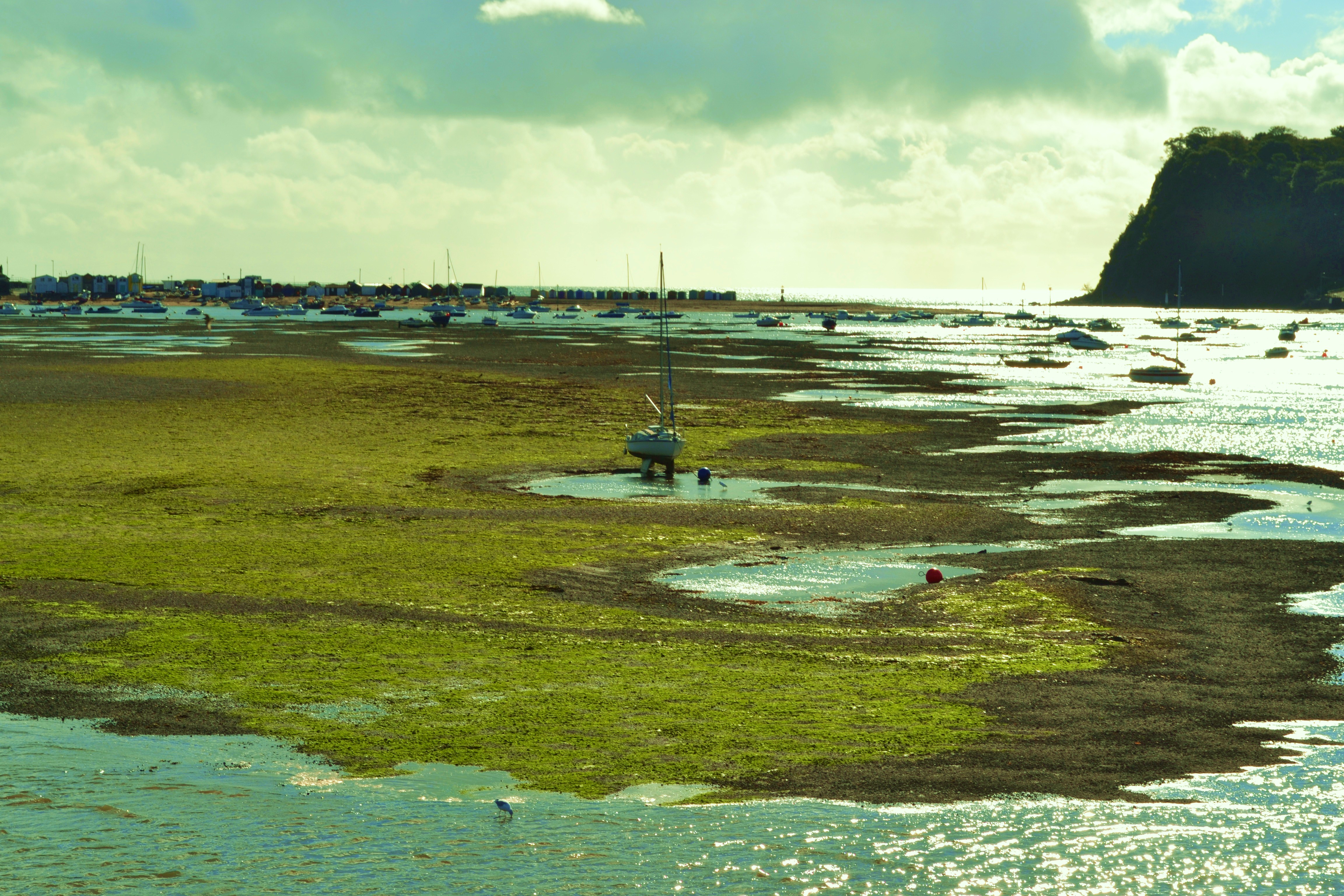
For years I’ve loved photography, but I doubted that I could understand how to use a proper camera. My new Nikon stayed in its box for over a month. This morning I went out to see what the harbour looked like through my lens. The water was sparkling and calm. As I focused on my shots I lost all sense of doubt. I simply pressed the shutter. I know that is the key to writing well.
I simply write my sentence.
 Horsemanship for Health