Yard Philosophy

18 04 2013

 Image

I studied philosophy as a mature student at Middlesex University and since graduating in 1999 I have been teaching some form of the subject as my main job. I love teaching philosophy. Sometimes it is difficult and demanding and requires me to concentrate harder than I think I can, but the rewards are always worth the mental effort.

 I’m now branching out with my teaching and leading philosophical enquiries in new settings including farms, barns and yards. Often in philosophy sessions the group ends up talking about animals. This week in a session with my A Level students I just happened to drop in a reference to cats and the room suddenly became electric as the students, well trained philosophers as they are now, furiously debated the merits of dogs over cats.

One line of argument was that dogs care more about humans because they share a house with us and rely on us to supply their needs whereas cats can come and go as they please. Cats don’t need us in the same way as dogs. So, my students argued, it seems that need is an essential ingredient in the devotion of dogs. Perhaps need is essential for devotion itself, but we didn’t get that far. We could easily have become absorbed in this topic. In the same way that we have been absorbed in the pressing philosophical question of whether Cheryl Cole is the epitome of female beauty, but we had to move on.

Given the delight and enthusiasm that animals provide as a focus for discussion, I’m starting a new philosophy project that invites people to think about animals in a deeper way. We live with our animals and they are part of our human community. The question that intrigues me is why we are so drawn to other species. What is it about a horse that compels us? A lot of my gifts at Christmas were horsey ones. I got a blanket, some horse mints (for when I’m feeling hoarse…) and a Spirit of the Horse calendar from my Mum. I’m not so good at flipping over the months. I feel comfortable with the familiarity of each particular month and get slightly stressed by going from one to another, but April’s quote was worth turning over for:

Wherever man has left his footprint in the long ascent from barbarism to civilization we will find the hoofprint of the horse beside it. – John Trotwood Moore.

Aside from loving that ‘Trotwood!’ I keep looking at the quote and wondering whether horses are still continuing in some way to civilize us. Compared to carriage horses of earlier centuries, farm horses, not to mention pit ponies and draught horses of all kinds, present day horses have lives of comparative ease. My horses largely do nothing all day while I toil away to keep them. Why do I go to all the trouble? What have horses given me? Bear in mind that I am asking this question five months after a severe knee injury meant riding my horse was off limits.

I’m going to argue that horses help us to understand what it means to be human. Horses complement our lives with their beauty, their power and their grace. We admire horses because they are a source of wonder to us, and that makes them perfect philosophical partners.

It was sluicing with rain for my first formal equine facilitated philosophy enquiry at Sirona Therapeutic Horsemanship and so contact with the horses was somewhat limited, but we still had plenty to puzzle over. Our chosen question: Do we have the right to tame animals? generated an enquiry that was rich, stimulating and varied.

Interestingly at the start of the enquiry we assumed that we did have the ‘right’ to tame animals merely by the fact that all the horses on the yard had been tamed and were animals working willingly with humans. So, the animals that we have tamed do not seem unhappy about it and therefore there was little scope for debate, but as the discussion deepened we asked a more nuanced version of the question which was: Do we have the right to educate animals? We wondered whether educating an animal still involved ‘squashing its spirit’ and some members of the enquiry thought that this was inevitable whereas others wondered whether animals even needed us around to educate them. Don’t they do a better job of it themselves?

Given ultimate freedom, would animals choose to be with us at all? Post enquiry, I’ve been mulling over this question during my brushing and muck clearing duties. I’ve been educating my horses for longer than a decade and my role remains a blend of teacher and slave. We’re pretty content in our small community of three and all get along well and take each other for granted as happens in many long-standing relationships. I’ve known my horses from birth and can track the arc of the first ten years of their ‘schooling.’

I know that they could have spent ten years in a field and bought themselves up, but if they had they wouldn’t be the horses they are today: they wouldn’t know how useful humans are for a start. They wouldn’t know that a human could climb on their back and take them somewhere they’ve never been before. They wouldn’t know how to trot at the click of a human voice. They wouldn’t know what it means to be friends with people.

Philosopher Mary Midgley argues elegantly that we live in a mixed community and that our ‘experience of animals is not a substitute for experience of people, but a supplement to it – something more which is needed for a full human life.’

I wonder whether this is also true of animals, especially horses in whose hoofprints we have walked for many years. Do they need us for a full animal life?

That question requires a longer philosophical ponder. I can feel the need for some more brushing and muck cleaning coming up.




Doing less to achieve more

23 03 2013

Image

One of the most valuable lessons I learned from working with my acutely perceptive editor Kate Parkin is how to let go of what I don’t need. Over the course of two books, Kate showed me patterns in my writing and made suggestions on how I could improve clarity. As a writer it’s humbling to watch your stylistic tics and idiosyncrasies slither into your work despite your best efforts to keep them out. In my case, some of my habits were tenacious. In early writing, I had a tendency to overdo description because I suppose I felt that I just hadn’t painted the scene in enough. Anything less than full saturated-colour felt lazy and lacklustre. Now I know better how to nail a scene with just the essential details. My choices as a writer have become simpler and more confident.

A good editor, and Kate is more than good, acts like an air traffic controller guiding the pilot author in the right direction so that she can deliver the book and come home safely. Sometimes the editor might have to step in and prevent the book from crashing. That’s not a situation I have yet had to face, but it’s comforting to know that were I to go veering completely off-course, Kate would find a way to gently bring me back.

A good editor, then, is grounding. One of my idiosyncrasies is a difficulty in understanding timing and that includes knowing when I’ve given enough. My tendency is always to do more than I think I need. Some parts of The Beautiful Truth were written at breakneck speed not only because I had a deadline to meet, but also because I was terrified that if I stopped to look up from the laptop and come back to real time I would never return to the scenes spooling across my mind like crackly old black and white news reels.

Knowing that I was delivering first to someone whose critical judgement I trusted before my work met the wide world was enormously encouraging in the same way that I imagine cross-channel swimming is made all the more bearable by knowing that there will be someone with towels and hot drinks ready for when you reach the far shore. Just someone to say: you made it. Well done. It’s enough.

Writing a novel is such a monumental effort of will that it’s hard not to chuck everything at it as you go along. My first two novels were written against the grain of my own resistance and the process of working on them not unlike the feeling of pitchforking sodden clay soil into a wet wheelbarrow. As this is something I do daily, I know how after a few weeks of this my shoulder muscles have packed up. Tired muscles can’t do the work they’re supposed to.

A year ago I didn’t know this, but my writing muscle needed a good rest. Years of pushing it to carry loads beyond its natural strength had weakened it. I found that whenever I started something new, instead of writing freely I was reaching for sentences that felt easy and familiar. I was also filling notebooks with plans for ever more ambitious projects and spending sleepless nights wondering how I was going to achieve them. I didn’t intend to stop working – I still don’t and will write until I’m ninety nine if I stay alive that long – but something in me made me slow down. Instead of racing into the next project, I let myself have a bit of drifting time. Colm Toibin calls this ‘staying in your mental pyjamas,’ and it is an essential part of the creative process.

I’m a little less drifty now. As spring approaches, I can feel my energy rising along with the urge to get back onto my hard little chair and hammer out another book. But even in my excitement and impatience, I’m trying to remember to take it easy and leave something in reserve.

This time around, I’m going to take another sound piece of advice from my editor and try to do less to achieve more.


Listen and Trust

5 03 2013

Image

One of things I find dismaying about the use of text and, to a certain extent, email is the lack of trust involved. It is easier to issue commands through text, to make your point without concern for nuance or tone, to act in pure self-interest. Each text is a flat communication. I have taken to ignoring texts I find offensive and the effect has been somewhat liberating. My lack of response may indeed seem rude in return, although I have yet to be challenged on my silence.  My response I have decided shall be this:

I’m always happy to talk with you. Please come and talk to me. I will listen.

All communication is a two-way process, a dialogue between those who wish to speak and those who listen to what is said. A text which denies the recipient the opportunity to listen short circuits the communication process.

If we have something valuable to say, we need to ensure that we have someone who is prepared to listen. Every time we write, we open the door to someone to listen. Every time we write and we acknowledge that there is someone out there who will listen, we build trust. Writing even a text without acknowledging the listener is not communication, it is shouting. And shouting erodes trust.

DID YOU NOT HEAR WHAT I SAID?

Have you ever been in a situation where someone is trying to make their point by forcing someone else to acknowledge their words? I have. I have witnessed this form of emotional bullying countless times. Unfortunately it has often been children on the receiving end. I shall never forget the visceral disgust I felt on witnessing an autistic teenage boy being yelled at by a senior teacher whose rage was so extreme it reduced all the classrooms in the corridor to silence.  I have had people try to force their opinions on me, and my response, too, has been silence.  

Silence is not the protest of the weak; it is the voice of the strong. Silence is the only response to any form of communication that abuses trust.

Trust begins when we can listen without fear of manipulation. Trust begins when we stop playing status games and start to listen.

In order to listen to others we must listen to ourselves. I realise that when I’m with a person who is determined to make their point without acknowledging my role as a listener that I get defensive. Instead of listening harder to myself, I start to lean in harder to what they are saying. In this way I become deaf to my own voice, my own thoughts, my own ideas. Rarely in my professional life do I meet someone who is truly interested in my ideas – most people talk because they want to share their ideas. A lot of people talk to writers because they think the writer can help them with their own writing project.

I’m getting better at going quiet on people who stop the communication process. It has made me realise that the people who value trust have the most to say. 


Injury time

9 12 2012

  Image

In sport, more play time is given at the end of some games to compensate for time lost to injury. In life, there is no such luxury. Injury time is part of the ordinary run of time, and there are no bonus hours of living to make up for time lost in the playing. Injury time is headless of plans and projects and must be accommodated on its own terms.

Being injured is something I’ve forgotten. It is nearly eight years since my knee injury and I thought I had cured it with regular walking and exercise. After a couple of minor falls on slippery mud and on ice, my knee has given way again, and this time I know that it is more serious than the first time. This time I know that it will be months before I can return to the level of activity I was taking for granted less than a week ago.

In less than a week my world has both shrunk and grotesquely enlarged. When I look at ordinary spaces transformed into parkland for giants, I feel like Alice in Wonderland. On the first day, I couldn’t cross the kitchen. Today at the hospital, a car park stretched like an expanse of grey English Chanel. My car, on the other hand, feels like an old wellington boot: a perfect fit.

Like many people who use their minds for a living, I reside mostly in a non-physical space and regard my body as the other part of me, the bit that accompanies my head. I keep fit, eat my greens and generally look after my body, but my sense of ‘me’ is not my hands, chest, shoulders, hips, thighs, knees or feet. I am not my flesh and blood. If I were a horse, I would be located in my loins, or my heart, or my powerful lungs. If I were a dog, I would be my sense of smell or my hearing. If I were a cat, I would be my balance and my timing. If I were a mouse, I would be my nerve endings. A falcon? I would be my eyes.

Because I am human, I am my thoughts. There seems no escaping from this and it is why people wish to be birds and why a friend once said that that the reason we admire and love animals so much is because we envy them.

Being injured returns us to the body. I have become disproportionately right-kneed. I wake thinking about my knee and spend all day making adjustments for it so that the rest of me can come through. I feel subdued, muffled by my lack of vivacity and also bemused because I now have a stick, a particularly fetching aluminium standard NHS issue elbow crutch. It is useful. It is my rudder. Because straightforward walking is not easy, I’ve been dreaming of movement in other dimensions. I want to recapture fluidity. I want to dance, to run, to climb, to leap, to move unequivocally.

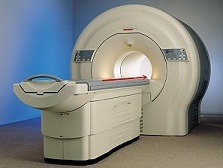
But in order to do so again I have to give injury time its proper due. So far, this has meant reading and eating a lot of chocolate. It has also meant this morning a visit to the mother of all magnets, the giant doughnut of the magnetic resonance imaging (MRI) scan. I was given yellow foam earplugs, but these still did not dampen the soundtrack that opened with clanging church bells and ran through a range of other frequencies including power drills, garage music, metal grinders and ships’ anchors being slowly winched ashore, and all of this was just action on my water molecules.

MRI scans work by rearranging the protons at the centre of each hydrogen atom, making them stand to attention all in one direction, like a magnetized cadet force. Protons pulled out of normal position emit radio signals and these can be mapped to create an image of the body. After the scan – it takes a surprisingly long 40 minutes – I asked the radiologist if I could see the pictures. He showed me one of the anterior ligaments still clinging to the bone and a blurred section inside the knee. ‘That all looks pretty mushy.’

Pretty mushy is accurate. My knee has the consistency of pond sludge. There is not much I can do to get things flowing again. Injury time will not be coerced; it will not be hurried. I must concede to it.

But still I can’t help wondering what I would do with the time if I were given say a fortnight at the end of my life to play out for free. Where would I go? What would I see? What would I stop doing immediately?

I’m going to have a think about this and report back next time